In this post, I will discuss the meaning of the three partial derivatives of the quadratic formula, with respect to each variable (a, b, and c). This is a pretty old concept of mine (I first thought about this about 6 months ago). It was also inspired by a video by blackpenredpen. However, he only took the partial derivative with respect to a, and he didn’t explore its geometric interpretation. I will be expanding on his idea.
As a refresher, I will write out the general quadratic equation and its formula:
First, we will take the partial derivative with respect to a. The calculation is simpler if we split the formula into two parts:\
We can tell that this derivative will be undefined if the discriminant is zero because it is in the denominator of the second term.
Second, the partial derivative with respect to b:
Again, the discriminant appears in the denominator of the second term.
Finally, the derivative with respect to c:
Interestingly, this quantity is the negative reciprocal of the square root of the discriminant (-1/sqrt(x) where x is the discriminant).
What do these derivatives mean?
These derivatives measure the rate of change of the solutions of the quadratic as you vary each coefficient.

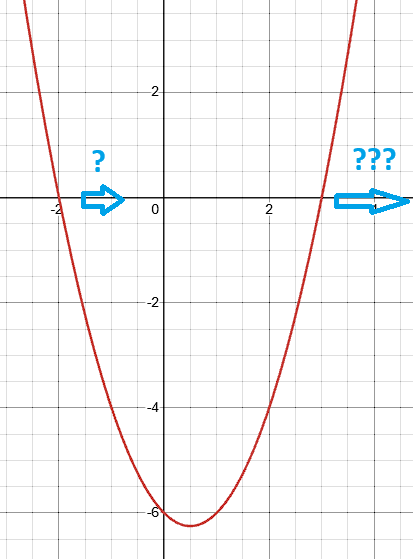
The equations in rows 5 and 6 correspond to the partial derivatives of the quadratic formula with respect to a, which I just derived. In this example, a is set to 1. The two numbers mean that if I increased a by an infinitely small step, the left root would move right at a rate of 0.8 small steps, and the right root would move left at a rate of 1.8 small steps.
This makes logical sense, because increasing a would increase the steepness of the parabola, which would push the two roots closer together: The left root would be moved right, and the right root would be moved left.

This is the same function, but I moved the partial derivatives with respect to b upwards (I typed them all out beforehand). Following the same logic, if I increased b, it would push both of the roots left, but the positive root would be more strongly affected by it.

Finally, increasing c would move the parabola upwards, pushing the two roots closer together by the same amount. The partial derivatives of c are opposites of one another, which means increasing c affects both roots by the same amount. This also makes logical sense, because all parabolas are perfectly symmetric around their vertex.

In the real world, these formulas could be used to calculate how changing the force of a bow shot changes the place where the arrow lands. Although, this is just a speculation.
Leave a Reply