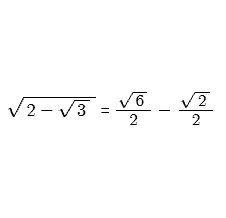
Nested radicals appear in many math problems, especially in trigonometry. They are expressions that have a root inside of another root, usually of the form √(x+√y). Example:
This is quite messy to look at, but under certain circumstances it can be simplified into two non-nested radicals. This example can be reduced to:
We can derive a formula to solve these problems without guessing. First, let’s write down the general nested radical and its simplified form:
Next, square both sides:
In this equation, the non-root parts and root parts need to be equal. We will equate them to form a system of equations:
Then, solve for a and b:
Let’s solve for a with the quadratic formula using 4, -4x, and y as the coefficients:
Let’s solve for b:
It doesn’t matter which solution you choose for a, but b must have the opposite sign. We will choose a positive solution and b as the negative solution going forwards. Substituting the values for a and b back into the equation, we get the following:
However, it looks like we just turned a nested radical into two more complicated nested radicals. This is because the formula only works if x²-y is a square number, meaning the inner square roots simplify.
If the nested radical instead has the form:
It will be a difference of two roots:
However, because the values must be squared to solve for a and b, this information is lost in the calculation. Through the equation above, we can arrive at a similar formula:
In this case, a has to be the positive root, or else the quantity would be negative instead of positive. More generally:
Example
This will simplify x²-y is a square:
It is a square, so the nested radical has a simpler form:
If we calculate approximations for the two quantities, we see that they are the same number:
Leave a Reply